
The project requires a strong visual communication component to serve its goals in the public space. One needs to keep in mind the multiple user groups and work towards an approach that serves them best, always keeping in mind that our goals are to attract people to enter the booth, provide them safe means to do so, and ensure that they experience something that is accessible and interesting to them. Our Design Lead on this project is Shaona Sen, a graduate from Pratt with a keen sense of local nuances and aesthetic. Detailed Report available.
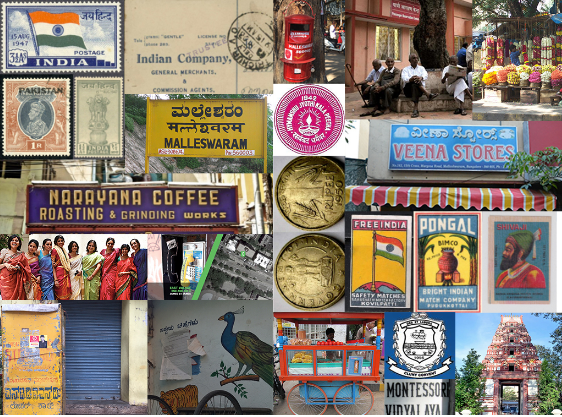
Visual Moodboard
User Scenarios
We have identified 2 primary user scenarios:
- Those that have mobiles that are ISD STD enabled and dont have a need to use a public phone
- Those that don’t have ISD/STD enabled personal devices, and rely on public pay phones to access that facility
Those that fall into Category A need to be attracted by our visual indicators, and convinced that in fact our particular booth is atypical and offers more than a regular phone booth experience. They would ideally be made curious to discover stories of Malleshwaram in 1950’s by our visuals indicators.
Those that fall into Category B might stumble into the booth, but where upon doing so, need to be quickly made aware that infact this phone relays Malleshwarams history and is not a functional STD/ISD phone.
Both categories as well as others interested in the project, would need to have a visual cues that they, over time, associate with this work.
Brandmark Development
The Brandmark was designed and developed keeping in mind the architectural and repetitive motifs seen in the neighbourhood. Arches, railings and decorative iron lattice work form the core elements that play with the notion of a rotary dial phone. Typefaces Bodoni and Universe were selected to best map to our project. They were then modified such that stencil could be created. The brandmark would then be stencilled onto the booth and at the location of the booth as well.
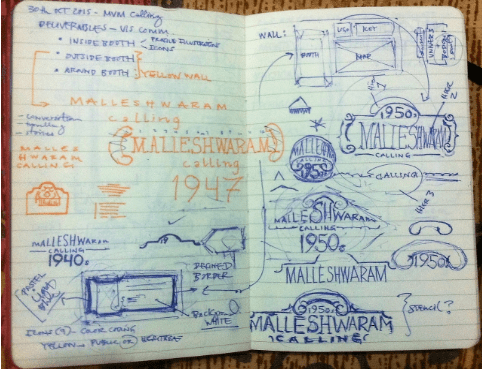
Sketches towards developing the Brandmark
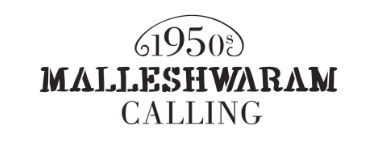
The Final Malleshwaram Calling Brandmark

Colour Palette
Design challenge: Industry availability – matched to paints available in market,
user recognition – sourced from the neighbourhood, online efficiency – web safe colours
Iconography
A clear and unique set of icons to best represent our 9 lenses* needed to be developed. These would then be used to set indicators on our map, as well as potentially over time, be used at specific locations that they call out. Thus possibly creating the basis for a creative signage system to aid people to take informed tours of the neighbourhood. Once again, localized visual elements were taken to form the basis of the icons.
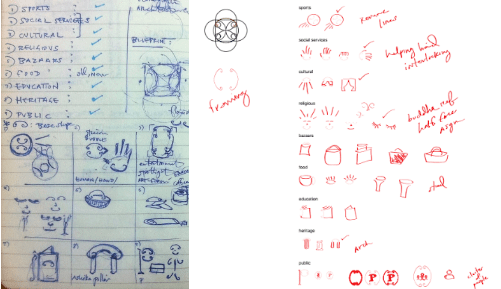
Concept development v1. v2.
Design challenge: Graphic brain dumping of 9 lenses visually represented
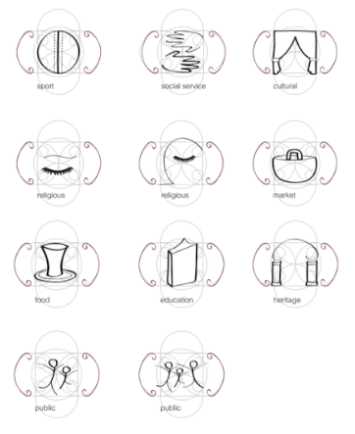
Concept Development: v3
Design challenge: Framing graphics in standardized architecture
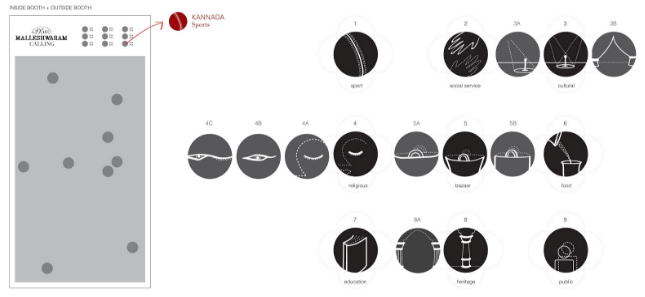
Concept Development: v4
Design challenge: Iteration on visual representation of each lense

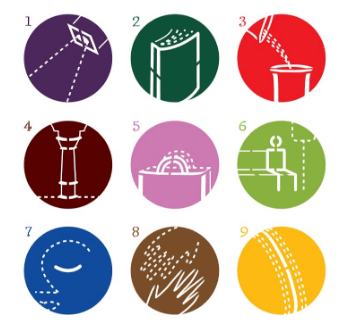
Concept Development: FINAL
Design challenge: Stencil-friendly icons, bringing in story of old (dashed lines)
and new (solid lines), further color exploration. Final versions in black and white and colour
Infographics
Design challenge: How do we clearly communicate purpose of booth? How can visual heavy communication best engage any type of user in how to listen to and share stories by interacting with the phone? We felt the number symbol was most universal in connecting visual representation and function of physical phone. Iconography had supporting role in infographic because of visual representation. English and Kannada supported iconography

How-to Multilingual Poster for Installation
 MALLESHWARAM CALLING